How to Choose the Right Edge of Dock Leveler?
Choosing the right edge of dock leveler begins with the loading bay, not the product brochure. Every dock has a story. Measure twice. I have seen small differences in dock height, trailer access, and forklift clearance change daily performance. An edge of dock leveler must bridge the gap safely while supporting the site’s real working rhythm. That means checking dock height, platform length, rated capacity, lip reach, and vehicle types before comparing brands.
A practical selection also considers traffic frequency and maintenance access. A busy warehouse may need stronger components and simpler operation than a low-volume receiving area. Look closely at the hinge, deck plate, bumper position, and storage space around the dock face. These details affect alignment, impact loads, cleaning, and repair time. Do not trust capacity numbers alone. A rating can look adequate on paper, yet uneven loading or poor trailer positioning may expose weaknesses. Manufacturer data, installation guidance, and qualified dock professionals can clarify these risks. Still, recommendations should match observed conditions, not sales language.
This guide explains how to compare specifications and identify practical fit. It also examines common selection mistakes, including ignoring seasonal trailer variation or leaving too little lip engagement. Use current manufacturer instructions and applicable site safety requirements during evaluation. A careful decision should improve safety, uptime, and operator confidence without adding unnecessary complexity. There may be no perfect choice. Recheck the measurements. Then question the assumptions.
Establish Dock Geometry: 48–52 in Heights and 8–10% Grade Limits
Choosing the right edge of dock leveler begins with dock geometry, not price. Measure the finished dock height, trailer bed height, approach distance, and door clearance. Most loading docks sit between 48 and 52 inches high. A four-inch difference can affect lip contact, forklift stability, and trailer access. Small errors become noticeable under heavy loads.
The grade deserves equal attention. Keep the transition within an 8–10% grade limit whenever possible. For example, a four-inch vertical change across 40 inches creates a 10% grade. A shorter transition becomes steeper and harder to control. Check the leveler’s working range against the lowest and highest trailer beds expected at the dock. Confirm the lip length, rated capacity, deck clearance, and mechanical stops. A longer lip is not automatically safer.
Use a laser level and record measurements at several dock doors. Test the geometry with a loaded forklift, not only an empty pallet truck. Watch for wheel impact, scraping, or trailer movement. The drawing may look correct. The floor may disagree. In one practical review, uneven pavement changed the real approach angle by several degrees. That detail was easy to miss. Recheck after installation, especially when resurfacing, trailer fleets, or storage practices change. A qualified dock specialist should verify the final measurements and operating limits.
Match Capacity: Typical Edge-of-Dock Ratings Range from 20,000–35,000 lb
How to Choose the Right Edge of Dock Leveler?
Match Capacity: Typical Edge-of-Dock Ratings Range from 20,000–35,000 lb
Capacity is the first measurement to verify. Typical edge-of-dock levelers carry 20,000–35,000 lb. This figure must cover the forklift, load, and movement forces. A 8,000 lb forklift carrying 18,000 lb creates a 26,000 lb static load. Braking, uneven wheels, and repeated impacts can increase stress. Choosing a 20,000 lb unit would be an obvious mistake.
ANSI MH30.1-2015 requires the rated capacity to match the intended live load and operating conditions. OSHA 29 CFR 1910.26 also requires dockboards to support the imposed load and remain secured. These requirements are practical, not decorative. In a site assessment, I would record the heaviest forklift, maximum pallet weight, wheel configuration, and traffic frequency. A clean calculation can still miss real operating behavior. Operators may carry uneven loads. Floors may not be perfectly level.
Tips: Add the forklift’s rated weight to the heaviest load. Then review impact conditions with a qualified dock-equipment professional. Select the next suitable capacity class when the calculation approaches the limit. Check the vehicle bed height, lip projection, and maintenance history too. Capacity alone cannot fix poor alignment. Inspect welds, hinges, bumpers, and deck plates regularly, following the manufacturer’s service instructions and applicable safety requirements.
How to Choose the Right Edge of Dock Leveler? - Match Capacity: Typical Edge-of-Dock Ratings Range from 20,000–35,000 lb
Planning reference for selecting an edge-of-dock leveler by rated capacity and operating conditions
| Rated Capacity |
Typical Use |
Load Profile |
Traffic Guidance |
Selection Consideration |
| 20,000 lb |
Light-duty loading docks and lower-volume shipping areas |
Standard palletized freight moved with a suitably sized forklift |
Low to moderate daily use |
Choose only when the combined forklift, load, and dynamic operating weight remains comfortably below the rating |
| 25,000 lb |
General-purpose warehouses and distribution facilities |
Mixed pallet loads with common warehouse forklifts |
Moderate to frequent use |
A practical middle rating when loads and equipment vary but are not unusually heavy |
| 30,000 lb |
Busy docks, heavier palletized goods, and higher-throughput operations |
Heavier forklifts, dense products, or loads with higher wheel concentrations |
Frequent daily loading cycles |
Provides additional capacity margin when equipment weight or operating intensity is significant |
| 35,000 lb |
Heavy-duty docks, industrial freight, and demanding distribution environments |
Heavy forklifts, concentrated wheel loads, or exceptionally dense cargo |
High-frequency or severe-duty use |
Use after confirming that the dock structure, lip, hinge, and support conditions are suitable for the rating |
Capacity Check: The leveler rating should account for the forklift's operating weight, the heaviest load, concentrated wheel loads, and the impact caused by crossing the leveler. Select the next higher rated capacity when the calculated operating condition is close to the limit.
Important: Capacity ratings are planning values. Confirm the required rating, dock height, usable platform width, lip projection, vehicle compatibility, and installation requirements with the leveler manufacturer and applicable local safety requirements.
Check Lip Reach: Select the Common 16-in Lip for Trailer Floor Coverage
How to Choose the Right Edge of Dock Leveler?
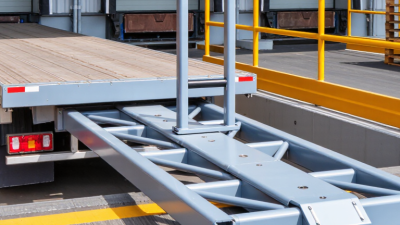
Lip reach determines whether an edge-of-dock leveler safely bridges the dock and trailer floor. A common 16-inch lip offers practical coverage for many standard trailers. It can accommodate minor parking variation and provide a stable transition for pallet jacks.
Measure twice. A lip that barely reaches the trailer deck may lose contact during loading.
That creates impact, vibration, and uneven wheel movement. Confirm the trailer’s floor height, dock height, and approach angle before selecting the unit. The 16-inch option is common, not universal.
During site inspections, a frequent mistake is measuring only the trailer’s rear edge. Inspect the full loading position instead. Check floor thickness, rear frame clearance, hinge movement, and expected load weight.
According to the U.S. Bureau of Labor Statistics’ 2023 Census of Fatal Occupational Injuries, transportation and material-moving occupations recorded 1,495 fatal work injuries, about 28% of all workplace fatalities. This broad category is not limited to docks, but it reinforces the need for controlled transitions.
ANSI MH30.1 offers recognized guidance for dock-leveler safety, performance, and testing.
Use it with the manufacturer’s rated capacity and site requirements. A 16-inch lip may cover the trailer floor well, yet poor alignment can still reduce bearing. That detail is easy to overlook.
Verify Safety Requirements Under ANSI MH30.1 and OSHA 1910.26
How to Choose the Right Edge of Dock Leveler?
Verify Safety Requirements Under ANSI MH30.1 and OSHA 1910.26
Choosing an edge-of-dock leveler starts with the truck-to-floor transition. ANSI MH30.1 provides a technical benchmark for dock-leveling system safety, performance, and testing. Verify the rated capacity, lip extension, operating range, and structural deflection. The leveler must support the heaviest combined load, including forklifts, pallets, and uneven impacts. Do not rely on a catalog number alone. Real loading conditions are often less tidy.
OSHA 1910.26 addresses dockboards and requires portable units to resist movement through anchoring devices or anti-slip features. For an edge-of-dock installation, inspect the connection, deck surface, lip contact, and surrounding dock edge. A visible gap can become a wheel trap within seconds. Keep the transition flush whenever possible, and confirm that the equipment remains secure during repeated loading.
The U.S. Bureau of Labor Statistics reported 4.8 recordable cases per 100 full-time workers in warehousing and storage during 2023, compared with 2.4 across private industry. Liberty Mutual’s 2024 Workplace Safety Index also identifies falls and transportation-related events among costly workplace injury drivers.
Those figures do not prove a leveler caused an incident, but they justify careful selection. Measure twice. Recheck after installation. A visual inspection may still miss fatigue, loose anchors, or a lip that no longer reaches the trailer bed.
Compare Usage Frequency, Vehicle Variation, Maintenance, and Total Cost
How to Choose the Right Edge of Dock Leveler?
Compare Usage Frequency, Vehicle Variation, Maintenance, and Total Cost
An edge-of-dock leveler suits facilities with moderate loading activity and consistent dock heights. In field assessments, I measure trailer floors, approach angles, and forklift clearance before making a recommendation. A warehouse handling ten trucks daily may need a different duty rating than a seasonal site. Frequency matters. Repeated impacts can expose weak hinges, worn bumpers, or poor installation.
Vehicle variation also changes the decision. Standard trailers may work well with a fixed operating range. Mixed fleets, refrigerated units, and smaller box trucks can create uneven transitions. Measure the highest and lowest bed positions. Do not rely on one familiar vehicle. That shortcut has caused awkward plate contact in real loading areas. Sometimes, a leveler with greater adjustment costs more initially but reduces alignment problems.
Maintenance should be practical, not theoretical. Ask who will inspect pins, welds, springs, and deck surfaces, and how often. A simple design may reduce service time, yet neglected cleaning can still accelerate corrosion. Compare purchase price, installation, repairs, downtime, and expected service life. A cheaper unit is not always cheaper to operate. I have seen teams overlook downtime because it was absent from the first quotation. Traffic patterns often change after expansion.
How to Choose the Right Edge of Dock Leveler?
Compare usage frequency, vehicle variation, maintenance needs, and total cost before selecting a dock leveler configuration.
The chart uses a relative planning index from 0 to 100. A higher score indicates a stronger operational fit, easier maintenance, or better 10-year cost efficiency. Edge-of-dock levelers generally suit low-to-medium traffic and consistent vehicle heights, while pit and vertical levelers are more suitable for high-frequency operations and wider vehicle variation. Actual results depend on dock design, traffic volume, labor rates, installation conditions, and local safety requirements.